
Labour Hiring Guide Oman: How Businesses Can Hire the Right Workforce in 2026
Hiring reliable workers is an important part of running a successful business in Oman. Companies operating in construction, manufacturing, oil and gas, logistics, hospitality, facility management, infrastructure, and other industries often need skilled, semi-skilled, and technical employees to maintain productivity and complete projects on schedule.
However, labour hiring involves much more than simply finding candidates and offering them a job. Employers need to define workforce requirements, source suitable candidates, evaluate their skills, verify qualifications, complete the required employment documentation, and ensure that workers are suitable for the role.
This labour hiring guide Oman explains the major steps businesses should consider when recruiting workers and how professional manpower companies can simplify the hiring process.
Why Labour Hiring Is Important for Businesses in Oman
A company’s workforce directly influences productivity, project timelines, service quality, and operational efficiency.
When businesses hire unsuitable workers, they may experience:
- Low productivity
- High employee turnover
- Additional training costs
- Project delays
- Increased recruitment workload
- Workforce shortages
- Operational disruptions
On the other hand, hiring employees with the right skills and experience can help businesses build dependable teams and maintain consistent operations.
For this reason, employers should follow a structured approach when recruiting workers in Oman.
Understanding Labour Hiring Requirements
Before starting recruitment, employers should clearly define what type of workforce they need.
Important considerations include:
Job Position
Identify the exact role that needs to be filled.
Examples include:
- Electricians
- Welders
- Civil Workers
- Mechanical Technicians
- Drivers
- Warehouse Workers
- Machine Operators
- Cleaners
- Hospitality Staff
- Maintenance Workers
Number of Workers
Determine whether the requirement involves one employee, several workers, or bulk hiring.
Skill Level
Define whether the position requires skilled, semi-skilled, technical, or general labour.
Experience
Specify the minimum experience required for the role.
Project Duration
Determine whether workers are required for permanent employment, temporary assignments, contracts, or specific projects.
Clear requirements make recruitment more efficient and improve candidate matching.
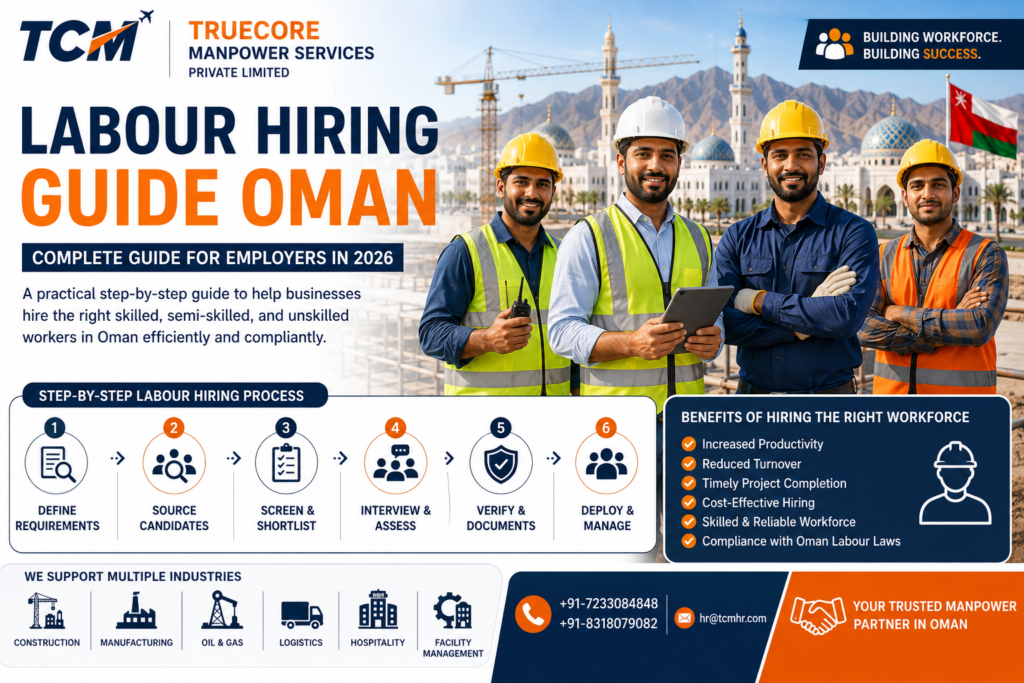
Step-by-Step Labour Hiring Process in Oman
1. Define the Workforce Requirement
The first step is to create a detailed workforce requirement.
Employers should identify:
- Job title
- Number of vacancies
- Required skills
- Experience
- Work location
- Working schedule
- Expected joining date
- Contract requirements
A clear job requirement allows recruitment specialists to search for appropriate candidates more effectively.
2. Source Suitable Candidates
Once requirements are established, employers can begin candidate sourcing.
Common recruitment channels include:
- Recruitment agencies
- Manpower companies
- Job portals
- Professional networks
- Employee referrals
- Recruitment databases
- International recruitment channels
For companies requiring multiple workers, professional manpower providers can offer access to established candidate networks.
3. Screen Candidate Profiles
Not every applicant will meet the requirements of a particular position.
Candidate screening should consider:
- Previous experience
- Technical skills
- Qualifications
- Job history
- Industry exposure
- Role suitability
A structured screening process helps reduce the number of unsuitable candidates reaching the final interview stage.
4. Conduct Interviews
Interviews allow employers to understand whether candidates are suitable for the role.
Depending on the position, interviews can assess:
- Technical knowledge
- Practical experience
- Communication skills
- Problem-solving ability
- Understanding of job responsibilities
- Workplace expectations
For technical positions, employers may also consider practical or skill-based assessments.
5. Verify Qualifications and Experience
Qualification and experience verification is an important part of responsible recruitment.
Employers or their recruitment partners should review relevant:
- Educational qualifications
- Technical certificates
- Employment records
- Professional experience
- Identification documents
- Other required documentation
Verification helps businesses reduce hiring risks and improve workforce quality.
Understanding Employment and Compliance Requirements
Businesses hiring workers in Oman should ensure that recruitment and employment procedures comply with applicable Omani laws, regulations, and government requirements.
Depending on the employee and employment arrangement, businesses may need to consider areas such as:
- Employment contracts
- Work authorization
- Identification documentation
- Visa and immigration procedures where applicable
- Employee records
- Health and safety requirements
- Payroll and employment obligations
- Applicable labour regulations
Because requirements can change, employers should verify current procedures with the relevant Omani authorities or qualified local professionals before completing recruitment.
A professional manpower provider can also help employers understand the documentation and recruitment processes applicable to their workforce requirements.
Hiring Skilled and Semi-Skilled Workers
Different industries require different workforce capabilities.
Skilled Workers
Skilled employees may include:
- Electricians
- Welders
- Plumbers
- Carpenters
- HVAC Technicians
- Mechanical Technicians
- Equipment Operators
Semi-Skilled Workers
Semi-skilled employees may support:
- Construction activities
- Warehouse operations
- Manufacturing
- Facility maintenance
- Hospitality operations
- Logistics activities
Employers should match worker capabilities with the actual responsibilities of the position.
Industries That Need Labour Hiring Services in Oman
Construction
Construction companies frequently require large numbers of workers across different trades.
Common requirements include:
- Civil Workers
- Masons
- Steel Fixers
- Carpenters
- Electricians
- Welders
- Plumbers
- Scaffolders
- Equipment Operators
Professional recruitment support can help construction companies manage project-based and bulk workforce requirements.
Oil and Gas
The oil and gas sector requires workers with specialized technical experience.
Common positions include:
- Mechanical Technicians
- Electrical Technicians
- Instrument Technicians
- Welders
- Pipe Fitters
- Maintenance Workers
- HSE Professionals
Recruitment for these roles should focus strongly on relevant experience and technical suitability.
Manufacturing
Manufacturing facilities require reliable workers to maintain production and equipment operations.
Typical positions include:
- Machine Operators
- Production Workers
- Maintenance Technicians
- Quality Inspectors
- Supervisors
- Industrial Workers
Logistics and Warehousing
Oman’s growing logistics sector creates workforce requirements across warehouses, transportation, and supply chain operations.
Businesses may hire:
- Warehouse Workers
- Forklift Operators
- Drivers
- Storekeepers
- Inventory Controllers
- Logistics Coordinators
Hospitality
Hotels, resorts, restaurants, and tourism businesses require employees across several departments.
Common roles include:
- Housekeeping Staff
- Chefs
- Waiters
- Kitchen Helpers
- Front Office Staff
- Maintenance Workers
- Customer Service Employees
Facility Management
Facility management companies require reliable employees for maintenance and daily property operations.
Positions may include:
- Electricians
- HVAC Technicians
- Plumbers
- Cleaners
- Maintenance Workers
- Supervisors
Labour Hiring Guide Oman: Direct Hiring vs Manpower Company
Businesses can recruit workers directly or work with a professional manpower provider.
| Factor | Direct Hiring | Manpower Company |
|---|---|---|
| Candidate Sourcing | Internal HR | Recruitment Network |
| Candidate Screening | Managed Internally | Professional Screening |
| Hiring Workload | Higher | Reduced |
| Bulk Hiring | Can Be Challenging | Easier to Coordinate |
| Skilled Worker Access | Depends on Internal Network | Wider Candidate Pool |
| Temporary Staffing | May Be Limited | Often Available |
| Recruitment Support | Internal | Specialized |
| Workforce Flexibility | Depends on Business | More Flexible |
The right option depends on the company’s workforce size, recruitment capabilities, project requirements, and hiring timeline.
Benefits of Using a Professional Manpower Provider
A professional manpower provider can support employers throughout different stages of recruitment.
Faster Candidate Sourcing
Established recruitment networks can help businesses identify suitable candidates more efficiently.
Reduced HR Workload
Recruitment specialists can manage sourcing, screening, and candidate coordination.
Access to Skilled Talent
Businesses can access candidates with different technical and professional backgrounds.
Support for Bulk Hiring
Large construction, industrial, and infrastructure projects may require many workers simultaneously.
Workforce Flexibility
Companies can explore temporary, contract, and project-based staffing options according to their operational requirements.
Improved Candidate Matching
Professional screening helps match workers with positions based on skills and experience.
Frequently Asked Questions
What is the best way to hire workers in Oman?
The best approach depends on the company’s workforce requirements. Businesses can recruit directly or work with professional recruitment and manpower providers.
What documents are required when hiring workers?
Requirements vary according to the employment arrangement and worker category. Employers should verify current documentation requirements with the relevant Omani authorities.
Can manpower companies help with bulk hiring?
Yes. Professional manpower providers can support bulk recruitment for construction, industrial, infrastructure, logistics, hospitality, and other projects depending on their recruitment capacity.
Can companies hire temporary workers in Oman?
Temporary and contract workforce solutions may be available depending on the employment arrangement and applicable requirements.
How can employers reduce hiring delays?
Employers can reduce delays by defining requirements early, maintaining recruitment pipelines, screening candidates efficiently, and working with experienced recruitment partners.
Conclusion
A structured approach to recruitment can make a significant difference for businesses operating in Oman’s competitive labor market. Employers need to consider workforce requirements, candidate sourcing, screening, skill verification, documentation, and deployment when hiring workers.
This labour hiring guide Oman provides a practical framework for businesses looking to improve their recruitment process and build a reliable workforce. Whether the requirement involves a single skilled worker or a large project-based team, careful workforce planning can reduce hiring challenges and support operational efficiency.
Professional manpower and recruitment companies can further simplify the process by helping businesses access skilled, semi-skilled, and technical candidates. They can support sourcing, screening, shortlisting, bulk recruitment, temporary staffing, and other workforce requirements according to the services they provide.
As Oman’s construction, industrial, logistics, energy, hospitality, and infrastructure sectors continue to develop, businesses that adopt proactive recruitment strategies will be better prepared to manage workforce demand and support long-term growth.